
Our Commitment to Sustainability
Acting in economically and ecologically sensible ways
Our goal is to strengthen an innovative and responsible economy while at the same time promoting a future-proof society. This includes conserving resources and considering the well-being of future generations. For our programmatic work as a nonprofit organization, this means specifically: We want to act in economically and ecologically sensible ways and reduce our carbon footprint to a minimum.
Internal Carbon Fee As an Incentive for More Sustainability
In doing so, we focus on responsibility and transparency, for our sustainability strategy is designed for the long haul. At the center of this strategy is a three-step approach: diagnosis, reduction, and elimination of CO2 emissions. We have established a clear process to measure, monitor, and report the impact of our activities. The goal is to be able to take appropriate measures to prevent and reduce our emissions. Prevention always takes priority over reduction.To calculate our emissions, we measure our Corporate Carbon Footprint (CCF) using the Greenhouse Gas (GHG) Protocol. The results guide us in taking effective action within the context of our sustainability strategy: For Scope 2 emissions that cannot be fully prevented, we use an internal CO2 price, the “Internal Carbon Fee.” This places a monetary value on greenhouse gas emissions and thus creates financial incentive. In addition, it allows us to take a fact-based approach to our processes.
In doing so, we focus on responsibility and transparency, for our sustainability strategy is designed for the long haul. At the center of this strategy is a three-step approach: diagnosis, reduction, and elimination of CO2 emissions. We have established a clear process to measure, monitor, and report the impact of our activities. The goal is to be able to take appropriate measures to prevent and reduce our emissions. Prevention always takes priority over reduction.To calculate our emissions, we measure our Corporate Carbon Footprint (CCF) using the Greenhouse Gas (GHG) Protocol. The results guide us in taking effective action within the context of our sustainability strategy: For Scope 2 emissions that cannot be fully prevented, we use an internal CO2 price, the “Internal Carbon Fee.” This places a monetary value on greenhouse gas emissions and thus creates financial incentive. In addition, it allows us to take a fact-based approach to our processes.
- Scope 1 comprises all direct greenhouse gas emissions, such as heating with gas or oil and a fleet of fossil-fuel vehicles. Since we do not generate these emissions, they do not factor into our calculations.
- Scope 2 comprises indirect greenhouse gas emissions such as electricity, district heating, steam, or cooling energy in buildings and in electric vehicles.
- Scope 3 comprises other indirect greenhouse gas emissions that are mostly related to our activities and events. These include, for example, the procurement of services and goods (office materials), waste disposal, water and sewage, business travel, and staff commute.

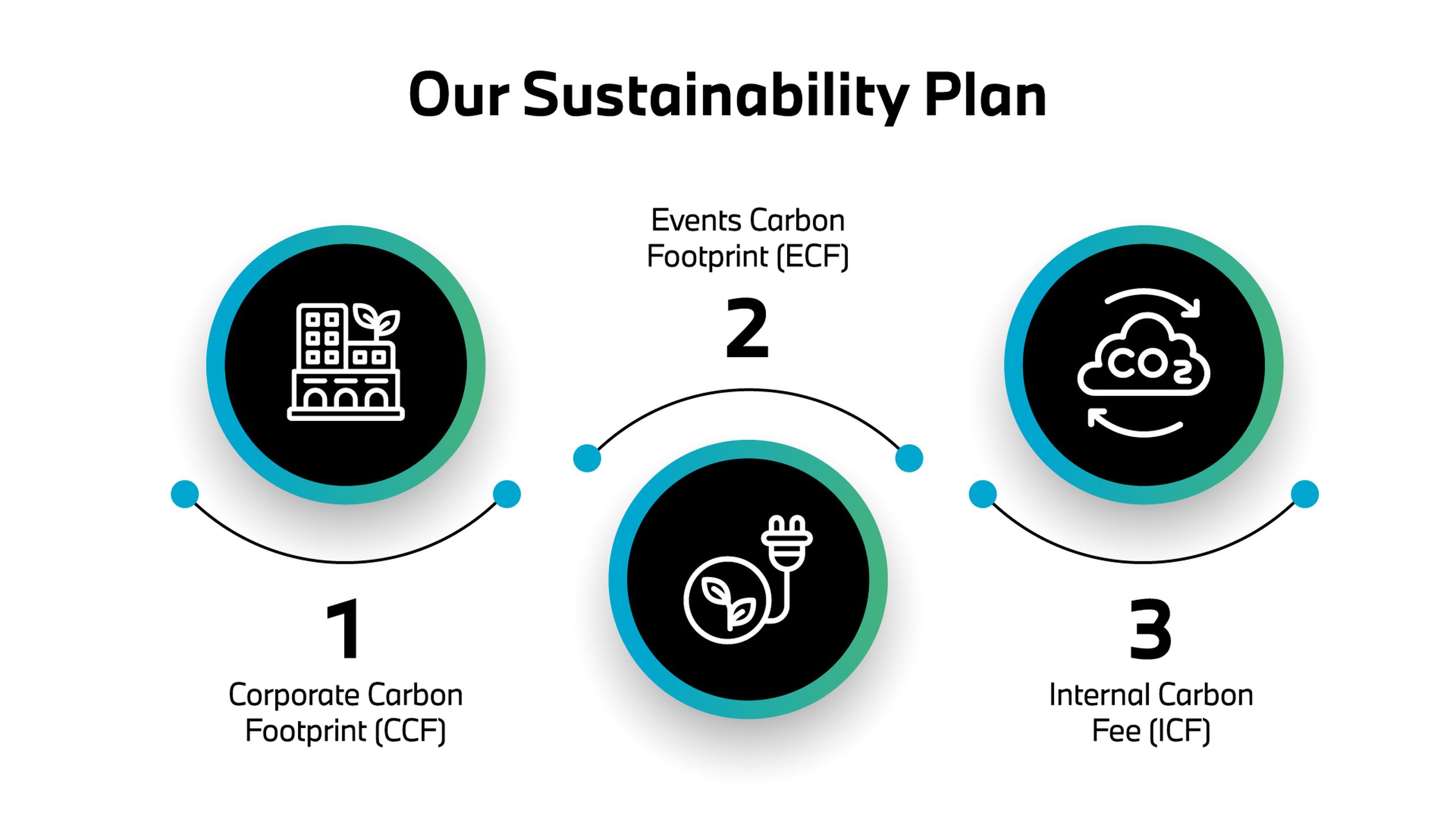
The Sustainability Plan of the Foundation concentrates on three key areas:
This includes measuring the CO2 emissions from the operation of our offices, including electricity and heating (Scope 2), staff commute, business trips, office supplies, water, and waste (Scope 3).
The Foundation takes steps to calculate and reduce the emissions of its events, both in terms of direct energy consumption and all relevant areas of event management.
The Foundation has introduced an internal carbon pricing system, which sets the cost at USD 100 per ton of CO2 equivalent.
Subscribe to our newsletter for news, upcoming events and impactful insights.