Science & Technology
Nobel Laureate Philippe Aghion on innovation and growth
How can Europe encourage innovation, help companies grow, and protect people whose jobs disappear? At the BMW Foundation’s Leaders Collaboration Forum, we discussed creative destruction, the energy transition, and AI with Philippe Aghion, winner of the 2025 Nobel Prize in Economic Sciences. He argues for a culture that allows failure, governments that support innovation, and schools where children learn to learn.
Coping with creative destruction
Creative destruction is at the heart of your work. How would you explain it to someone who is not an economist?Aghion: When you introduce a laptop, typewriters disappear. That is creative destruction. In a sense, you build on typewriters: the keyboard is like the one on a typewriter. New innovations build upon previous discoveries, but they drive out previous technologies. Another example is photography. You used to take a photo, go to the store to have it developed, and come back a week later to pick it up. Now you have mobile phones and digital photography, and that almost completely replaces non-digital photography. Some people still do it the old way, but this is another example of creative destruction.Can you give us an example of good creative destruction — and of bad creative destruction?Travel agents. We used to go to a travel agent and queue there to book tickets. Now you can do it online. I think that’s cool. A bad example – hard to say. Fast food, for example. I do not think it’s great. It makes people sick. That is not good creative destruction.The companies that benefit from innovation do not always welcome the next innovation. How do you deal with that?You destroy the returns of the previous innovators. The thing is that you need those returns to motivate innovation, but yesterday’s innovators are tempted to use them to prevent subsequent innovations. They do not want to be subject to creative destruction themselves. So you need a system with patent protection and property rights protection to make sure that innovators are not expropriated. At the same time, you have to make sure they do not use their returns to prevent subsequent innovations because they want to delay creative destruction.
What does creative destruction mean for someone whose job disappears?The idea is not really to prevent job losses. It is to make sure that those who lose their jobs are protected. That is where the Danes are ahead of everybody. They invented something called “flexicurity.” When you lose your job, you have unemployment insurance, and the state retrains you and helps you find a new job. I think that is a very good system. We should emulate it. With AI more than ever, we will need a system like that.What about people and communities who are afraid of further change?They feel left out or despised. That is why they often go for the populists. Look at the Yellow Vest movement in France. For years, we encouraged people to live in remote suburbs, and there were no trams or suburban rail systems. Then suddenly we raised the price of gasoline. Of course, people revolted. We should have a system where, whether you work or train, you have a decent income. Your children will go to good schools. You will have access to a good healthcare system. Then people will be much more willing to take risks.Is AI already taking creative destruction too far?There is a danger of too much job destruction. Some people think you should slow it down. It is very hard to slow down progress. I think it is much better to have a labor market system that accommodates creative destruction. One important thing is to have a good education system where you learn to learn. So a large part of schooling should be without AI. I believe children should be allowed very little AI at school. Maybe it can be used for students who are lagging behind, but a lot of schooling should be without it.Kids should read books on paper, from beginning to end, and concentrate on a book. They should concentrate on a mathematical proof. They should learn to write without mistakes, learn grammar, and calculate on their own. At school, you learn to learn. Then you become adaptable and learn to face problems.
In need of institutional investors
You describe support for people as essential to innovation. Is innovation a societal process?There is a triangle: the state, the economic sector, and civil society. You need companies to innovate. You need governments to enforce competition, design smart industrial policy, and provide education. And you need civil society to make sure that yesterday’s innovators do not collude with government to prevent competition and new entry. That is why civil society, the media, and consumer organizations are important: to make sure you do not have corruption, meaning collusion between yesterday’s innovators and the government.Europe has plenty of startups. Why do we struggle to turn great solutions into competitive businesses?Startups alone are not enough. The problem in Europe is that the best startups go to grow in the United States. We need firms that can grow in Europe, and they do not grow for supply and demand reasons. On the demand side, each country adds its own regulation to European regulation. That is called gold-plating. We should have a truly unified market, because when you have a small market, you cannot grow. We need more public procurement and industrial policy at the European level, because that is also a source of demand. In the United States, they have, for example, DARPA, the Defense Advanced Research Projects Agency. We need things like that in Europe.On the supply side, too much red tape limits venture capital. We also need more institutional investors, pension funds, and mutual funds. They have developed in Sweden, but not enough in the rest of Europe. And they invest too much in the United States because there is a market there.
“We need more public procurement and industrial policy at the European level, because that is also a source of demand."
Philippe Aghion

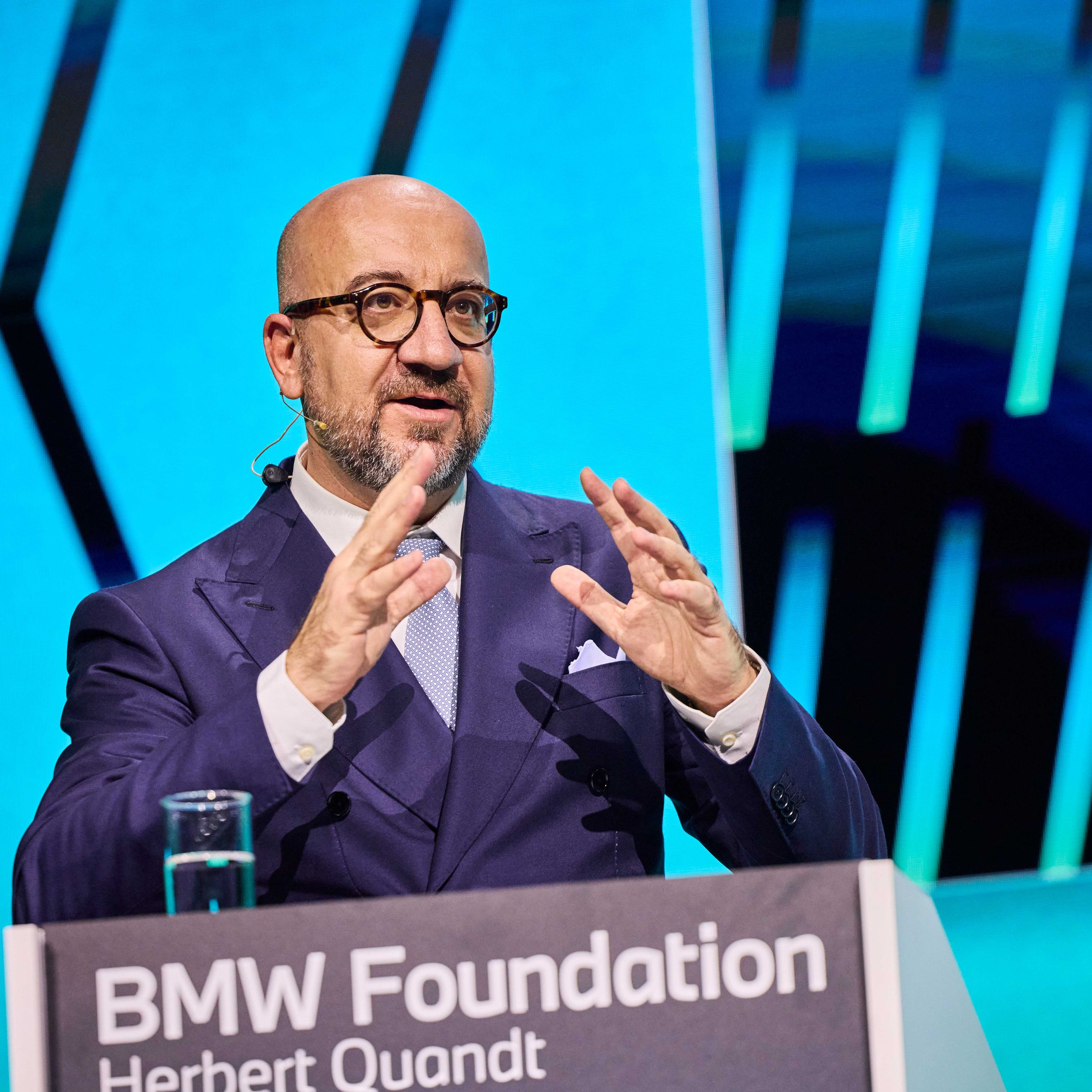
Philippe Aghion giving his keynote speech at The Leaders Collaboration Forum 2026 in Berlin.
Marc Beckmann
Is it also a question of Europe’s attitude toward risk and failure?Partly. We penalize failure. In the United States, they encourage it. They say, “You failed because you tried.” That is not anchored in our culture. In my school, failure was punished. But it should be encouraged! In addition, long-term research funding is very important for taking risks in research, venture capital is important for startups to take risks, and institutional investors are important to encourage large firms to take risks. It is really about the culture of risk-taking at all stages of the innovation process.Do you expect the EU to implement the competitiveness agenda proposed by Mario Draghi, former president of the European Central Bank?Some people think the Draghi agenda will be implemented at the EU level. I do not believe it. Have you ever tried to get into the Berlaymont, the European Commission’s headquarters? It takes an hour. It will not happen there. It will be a coalition of the willing. I very much hope that France, Germany, and the UK will be at its core. The UK is very willing, and they are a very serious partner. Canada wants to join as well. Canada’s prime minister, Mark Carney, has a vision: mid-sized countries that share values, freedom, respect for human rights, democracy, a social model, and concern for the environment. We share those values. We should have stronger cooperation. Then we can deal with the United States whenever it is profitable, or with China whenever it is profitable. But the core should be this set of mid-sized countries that share those values.So the coalition would not be limited to European countries?No. There may be some European countries that are not in it, and some countries outside Europe that are, like Canada.Can this cooperation also help Europe compete in AI?Absolutely. AI is data, computing power, and brains. We have the data. We have the brains. When it comes to AI research, Europe is as good as the United States. When it comes to patenting, the United States is a bit ahead. And when it comes to using AI in customer service or human resources, we are way behind. But we have lots of savings in Europe. We have a better social model than in the United States. We have our values: freedom and democracy. We have everything to do the next AI revolution, with AI that carries our values. What needs to happen is for this coalition of the willing to get together and say: We have a joint market for high technology. We will have joint DARPA initiatives and joint institutional investors. We will have more long-term research funding, particularly for AI. We will do those things together, and then it will happen.

Startups from the BMW Foundation RESPOND accelerator showcased their cleantech solutions at the Forum.
René Arnold

Production of green steel in Sweden.
Chiquita Clarissa

The PCK refinery in Schwedt, Germany, faces the challenge of transitioning from fossil fuels to cleaner energy sources.
Marc Beckmann
Green industrial policy
One area for cooperation is the energy transition. Can it become a driver of European innovation and prosperity?I think so. The green innovations we can develop are huge. When we built railways in France, it was a co-investment between the public and private sectors. A mixture of private and public investments is a competition-friendly way to do industrial policy. That is what we need for the energy transition. The problem in Europe is that we use too much emissions trading and carbon pricing. I believe in carbon pricing, but that is not enough. We will not solve the problem only through carbon pricing. We need green industrial policy.Do we really need more growth when the planet is already reaching its limits?I am not after GDP growth per se. I am interested in growth in living standards. Growth in health means that you will cure cancers. That is growth for me. Many aspects of our lives have improved in ways that are not necessarily captured by GDP. GDP is part of the story, but it is the tip of the iceberg. You go to a dentist nowadays, and you do not suffer like you did sixty years ago. That is something you want. You do not want to stop that kind of progress.How can you make sure that living standards grow while polluting less? You move from quantity to quality. You encourage quality improvements. Those are very much service-led, and they are not so polluting. Then you need green innovation for the rest. You need to find new sources of energy that are cleaner.
"Germany should reintroduce nuclear."
Philippe Aghion

The Almaraz nuclear power plant in Cáceres, Spain, April 2026.
Nuria Gonzalez Sanch
Going extra-terrestrial
Which technologies should we pursue?I think nuclear. I know you do not like nuclear in Germany. You should reintroduce nuclear. In the meantime, you invest in renewables. One day there will be nuclear fusion, but for now, nuclear is a clean source of energy. You should have it. We should pursue hydrogen as a source of energy too. That is, to slow down the rise in temperature. Then you have innovations that help you adapt to the climate. In France, many people died from heat waves last summer. We need air conditioning. It is true that it consumes energy, so we need to innovate in air conditioning systems. The sea level is rising. You will need new dikes, cheaper ways to build them, and more robust ones. Those are adaptation innovations.Your faith in innovation even goes extra-terrestrial. Could this help us respect the limits of our planet’s resources?When you live in a world without innovation, you are bound to think in terms of limited resources. But when you have innovation, you can always find new ways. One day, if we have limited resources, we can go to Mars and other planets to get them. We will.You really believe that?Of course it will happen. Why not? What would prevent us from going to Mars to get minerals?

Questions? Contact us.

BMW Foundation Team